
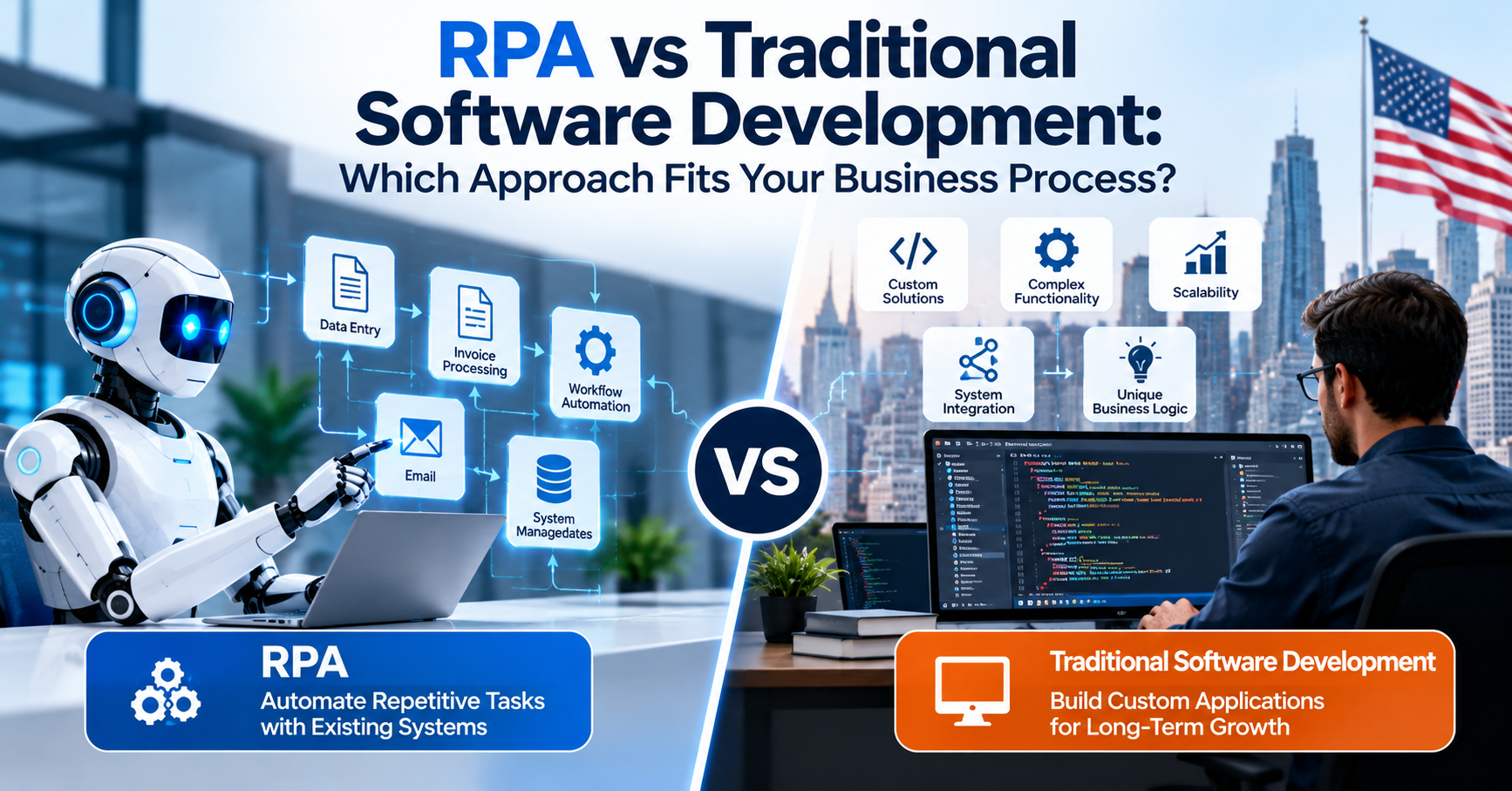
Businesses across the USA are investing in automation to reduce manual work, improve productivity, and streamline operations. However, choosing between Robotic Process Automation (RPA) and traditional software development can be challenging. Both approaches solve business problems, but they work differently.
RPA is generally suitable for automating repetitive, rule-based tasks, while traditional software development is better for building customized applications, complex business logic, and long-term digital solutions. The right choice depends on your workflow, existing systems, budget, and business goals.
Robotic Process Automation (RPA) uses software bots to perform repetitive tasks by interacting with existing applications. These bots follow predefined rules to transfer data, fill out forms, process invoices, update records, and generate reports.
One major advantage of RPA is that businesses can automate certain workflows without rebuilding their existing software. This makes it useful for organizations that rely on legacy applications or systems with limited integration capabilities.
Common RPA use cases include invoice processing, employee onboarding, data entry, report generation, order processing, and CRM updates.
Businesses evaluating RPA Implementation Services in USA can use this approach to identify repetitive workflows that are suitable for automation.
Traditional software development involves designing, coding, testing, and maintaining software applications according to specific business requirements. Developers can build new platforms, create custom features, integrate databases, and develop complex workflows.
Unlike RPA, which typically automates tasks within existing applications, custom software development can change how a process operates at the application or system level.
For example, a company that needs a custom inventory management platform with user roles, real-time reporting, and specialized business rules may benefit more from custom software development.
This approach offers greater architectural control and flexibility when building solutions for unique or evolving business requirements.
| Factor | RPA | Traditional Software Development |
|---|---|---|
| Main purpose | Automates repetitive tasks | Builds applications and custom functionality |
| Implementation | Often faster for focused workflows | Usually requires more development time |
| Existing systems | Works through interfaces or supported integrations | Can use APIs, databases, and custom integrations |
| Customization | Depends on platform capabilities | Supports extensive customization |
| Best suited for | Stable, rules-based processes | Complex, unique, or evolving requirements |
| Maintenance | Bots may need updates after interface changes | Depends on architecture, code, and system changes |
Neither approach is universally better. The most effective option is the one that meets the process requirements while remaining maintainable and cost-effective.
RPA is worth considering when employees repeatedly perform the same digital tasks, the process follows clear rules, and the existing applications already support the required workflow.
For example, an accounting team may collect invoice details from multiple systems and enter them into an accounting platform. An RPA bot can automate these predictable actions, reducing manual effort and repetitive data entry.
RPA may be appropriate when businesses want to automate legacy applications, improve process consistency, or achieve targeted automation without developing an entirely new application.
Professional RPA implementation services can help businesses assess automation opportunities, select suitable processes, configure bots, and establish monitoring and exception-handling procedures.
Custom software development may be the better choice when a business needs a new application, specialized functionality, complex integrations, or a platform designed around unique operational requirements.
For example, a logistics company building a proprietary shipment tracking platform may need custom databases, APIs, user interfaces, and real-time data processing.
Software development can also be preferable when a process depends heavily on complex business logic or when long-term integration through APIs is more reliable than automating changing user interfaces.
Before choosing, businesses should evaluate the full lifecycle cost, including development, licensing, maintenance, testing, security, and future upgrades.
Yes. Many organizations benefit from combining both approaches.
Custom software can manage core business logic, databases, and API integrations, while RPA bots handle repetitive actions in legacy applications that cannot be easily integrated.
For example, a custom order management platform could process business rules and customer data, while RPA transfers approved information into an older ERP system.
This hybrid approach allows businesses to automate existing workflows while developing more scalable digital infrastructure over time.
Choose RPA for stable, repetitive, rule-based tasks. Choose traditional software development when you need a customized application, complex functionality, or deeper system integration. Consider a hybrid approach when both requirements exist.
The best decision starts with understanding your current processes, technical limitations, expected outcomes, and long-term costs.
Looking to automate business workflows without choosing the wrong technology? Explore Ethos Verge’s Intelligent Process Automation services to discuss your requirements and identify suitable automation opportunities.
