
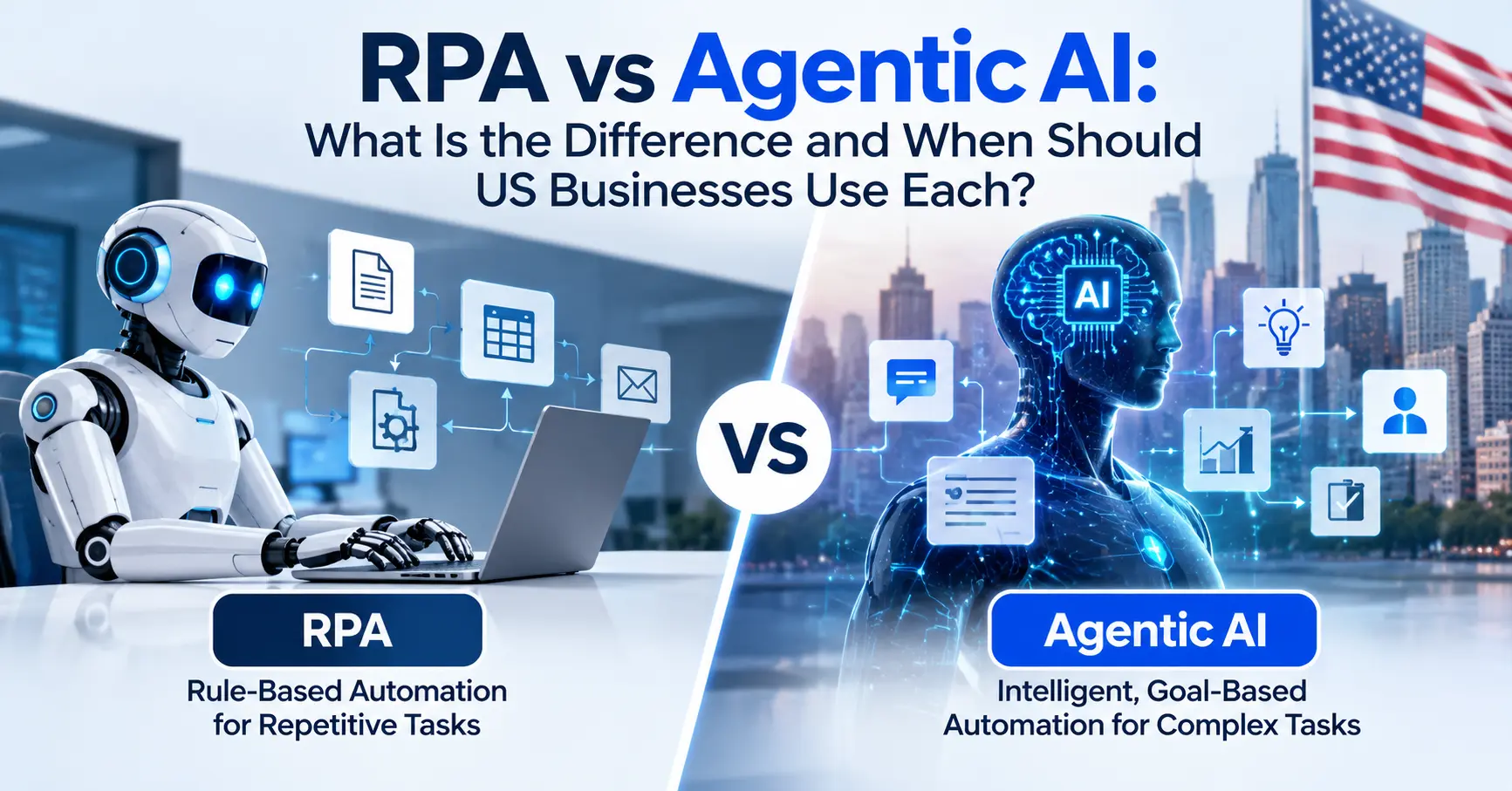
Businesses in the USA are increasingly using automation to reduce repetitive work, improve operational efficiency, and help employees focus on higher-value activities. But with the growth of Agentic AI, many companies are asking: Should we use RPA or Agentic AI?
The answer depends on the type of process you want to automate. RPA is designed for structured, rule-based tasks, while Agentic AI is designed for more dynamic tasks that require reasoning, planning, and adaptation. In many enterprise environments, both technologies can work together.
Robotic Process Automation (RPA) uses software bots to perform repetitive, rule-based tasks across business applications. An RPA bot can follow predefined instructions to enter data, move information between systems, process forms, generate reports, or update records.
For example, a finance team may use RPA to extract information from invoices and enter it into an accounting system. Because the workflow follows predictable rules, RPA can provide consistent and repeatable execution.
Businesses looking for RPA Services in USA can use RPA to automate processes across finance, healthcare, HR, customer service, insurance, manufacturing, and other departments.
Agentic AI takes automation a step further by allowing AI systems to interpret information, reason about a goal, select actions, and adapt to changing situations.
For example, an AI agent could receive a customer request, understand the intent, review information from multiple systems, determine the next action, and initiate the appropriate workflow.
Unlike traditional RPA, which generally follows predefined steps, Agentic AI can work with more variable and unstructured information such as emails, documents, conversations, and complex business requests.
The biggest difference is how the technology handles a process.
| RPA | Agentic AI |
|---|---|
| Rule-based automation | Goal-based automation |
| Best for structured data | Handles structured and unstructured information |
| Follows predefined workflows | Can reason and plan actions |
| Highly predictable execution | More adaptive execution |
| Ideal for repetitive tasks | Ideal for dynamic processes |
| Works well with existing applications | Can coordinate multiple tools and systems |
RPA is particularly useful when a business process can be clearly defined with predictable inputs and outputs. Agentic AI becomes useful when the process requires interpretation, decision-making, or adaptation.
RPA is a strong option when the process is repetitive, rule-based, high-volume, and stable.
Common RPA use cases include:
For example, if employees repeatedly copy customer information from emails into a CRM using the same workflow, RPA can automate those steps efficiently.
Companies evaluating RPA implementation services should first identify processes with high transaction volumes and clearly defined rules.
Agentic AI can be considered when automation requires greater flexibility or interpretation.
Potential use cases include:
However, businesses should consider governance, data quality, security, access controls, and human oversight before deploying AI agents in important workflows. Enterprise AI platforms increasingly combine agents, robots, people, and governance rather than treating them as completely separate technologies.
Yes. In many cases, the most practical approach is to combine them.
Agentic AI can interpret a request, determine what needs to happen, and decide which workflow should run. RPA can then execute deterministic actions inside existing applications.
For example, an AI agent could understand an incoming invoice and identify the required workflow, while an RPA bot enters approved information into an ERP system.
This combination creates an intelligent automation approach where AI handles reasoning and RPA handles reliable task execution.
There is no single solution for every process. If your workflow is repetitive, structured, and rules-driven, RPA may be appropriate. If it involves unstructured information, changing conditions, and more complex reasoning, Agentic AI may be worth evaluating.
For organizations in the USA, the right approach is to assess each process individually and select the technology based on its complexity, data, risk, integration requirements, and desired business outcome.
