
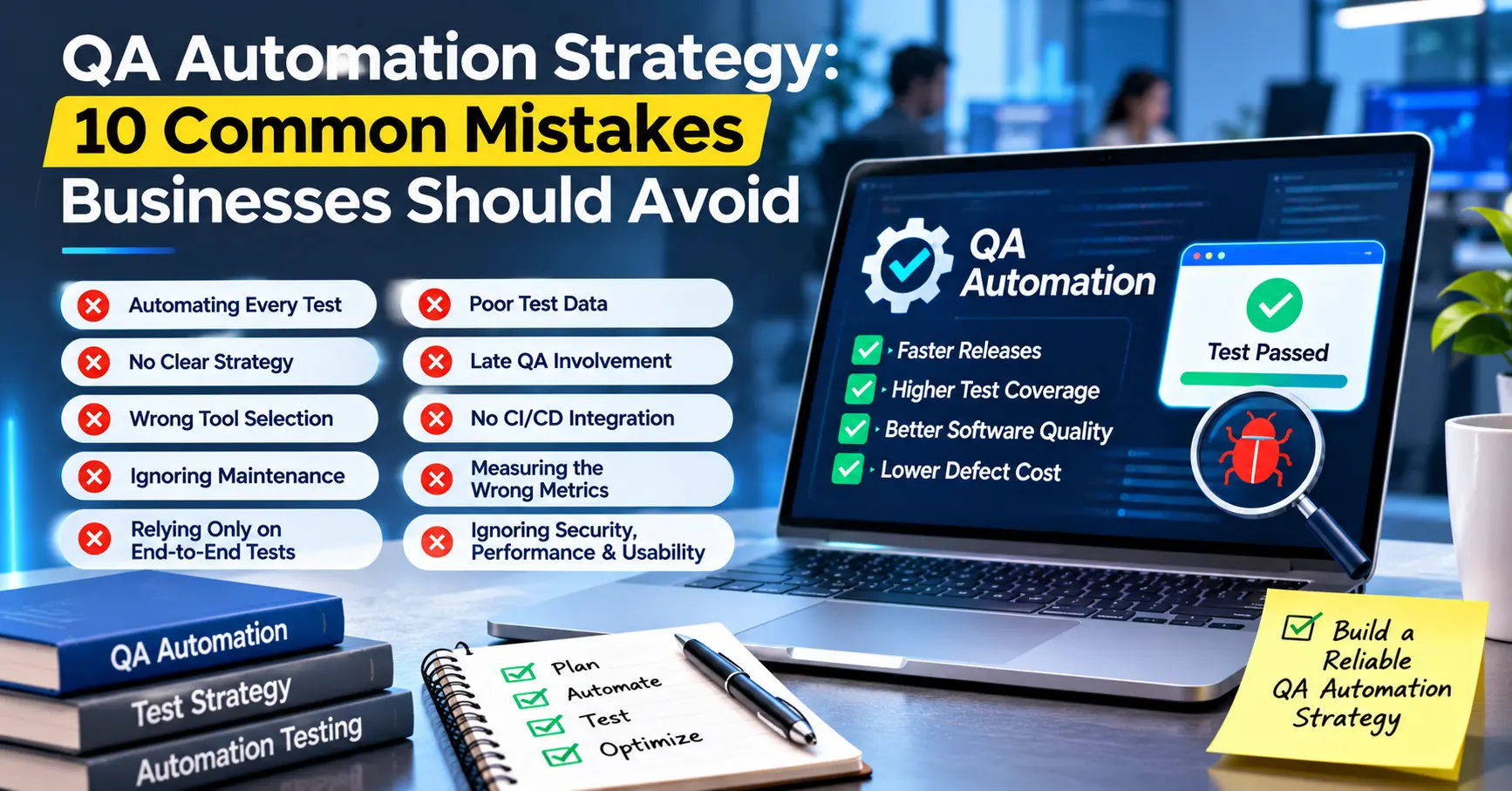
QA automation helps businesses improve software quality, reduce repetitive testing, and release updates with greater confidence. However, automation does not automatically eliminate bugs or guarantee faster delivery. Without a clear strategy, businesses can end up with unreliable tests, rising maintenance costs, and gaps in test coverage.
For organizations evaluating the top software testing companies in the USA, understanding these common mistakes can help build a more effective quality assurance strategy.
Not every test should be automated. Frequently repeated, stable, and business-critical scenarios are often strong candidates, while exploratory tests may still require human judgment.
How to avoid it: Prioritize tests based on repetition, risk, stability, execution time, and expected business value.
Launching automation without defined objectives can lead to duplicated tests and wasted resources. Teams may focus on the number of automated scripts rather than whether testing improves product quality.
How to avoid it: Define measurable goals, testing scope, responsibilities, tools, timelines, and success criteria before implementation begins.
Selecting a popular automation tool without assessing your technology stack can create integration and maintenance problems. Different applications may require different testing approaches.
How to avoid it: Evaluate application architecture, programming languages, browser and device requirements, team skills, licensing costs, and CI/CD compatibility before choosing tools.
Applications change frequently, and automated scripts can break when interfaces, workflows, or business rules change. Outdated tests create false failures and reduce confidence in test results.
How to avoid it: Assign ownership, review failing tests regularly, maintain reusable components, and update test scripts alongside application changes.
End-to-end tests validate complete user journeys but can be slower and more fragile than lower-level tests. Depending exclusively on them may increase execution time and troubleshooting effort.
How to avoid it: Balance unit, API, integration, and end-to-end testing. Prioritize end-to-end automation for critical business workflows.
Tests using incomplete, outdated, or unrealistic data may miss defects that appear in production. Sensitive information can also create privacy and security risks.
How to avoid it: Prepare representative test data, cover important edge cases, isolate test environments, and follow appropriate data protection practices.
When testing begins only after development is complete, defects can become more expensive and time-consuming to resolve.
How to avoid it: Involve QA professionals during requirement analysis and design. Review acceptance criteria early and introduce testing throughout the software development lifecycle.
Running automated tests only before a major release delays feedback and allows defects to remain undetected for longer.
How to avoid it: Integrate appropriate automated tests into continuous integration and delivery pipelines. Use fast checks for frequent feedback and broader regression suites at suitable stages.
A large collection of automated scripts does not necessarily mean effective testing. High script counts can hide weak coverage, flaky tests, and recurring production defects.
How to avoid it: Track meaningful metrics such as defect leakage, test execution time, flaky-test rate, critical workflow coverage, maintenance effort, and release stability.
Functional automation alone cannot establish that an application is secure, responsive, accessible, or easy to use.
How to avoid it: Combine functional automation with risk-based security checks, performance testing, accessibility validation, and targeted manual exploratory testing where appropriate.
A strong QA automation strategy starts with business priorities, selects the right tests and tools, and continuously measures quality outcomes. It combines automated execution with human expertise instead of treating automation as a replacement for every testing activity.
Businesses seeking professional support can explore QA & Testing services for test automation, functional and regression testing, API testing, mobile testing, and performance and security validation.
Whether you are improving an existing framework or planning automation for a new application, a structured QA approach can help your team identify defects earlier, make better release decisions, and deliver more reliable software.
